
Last updated: September 2026. Programme rules checked against airline and bank sources.
A friend told me last month that he had “about 80,000 miles” saved up and asked which flight he could book with them. Turned out he had 80,000 HDFC reward points sitting in NetBanking. No miles at all. Not one.
He is in good company. In India, “points” and “miles” get used as if they are the same thing, and the gap between them is where a lot of value quietly goes missing. They are two different currencies, held in two different places, worth two different amounts.
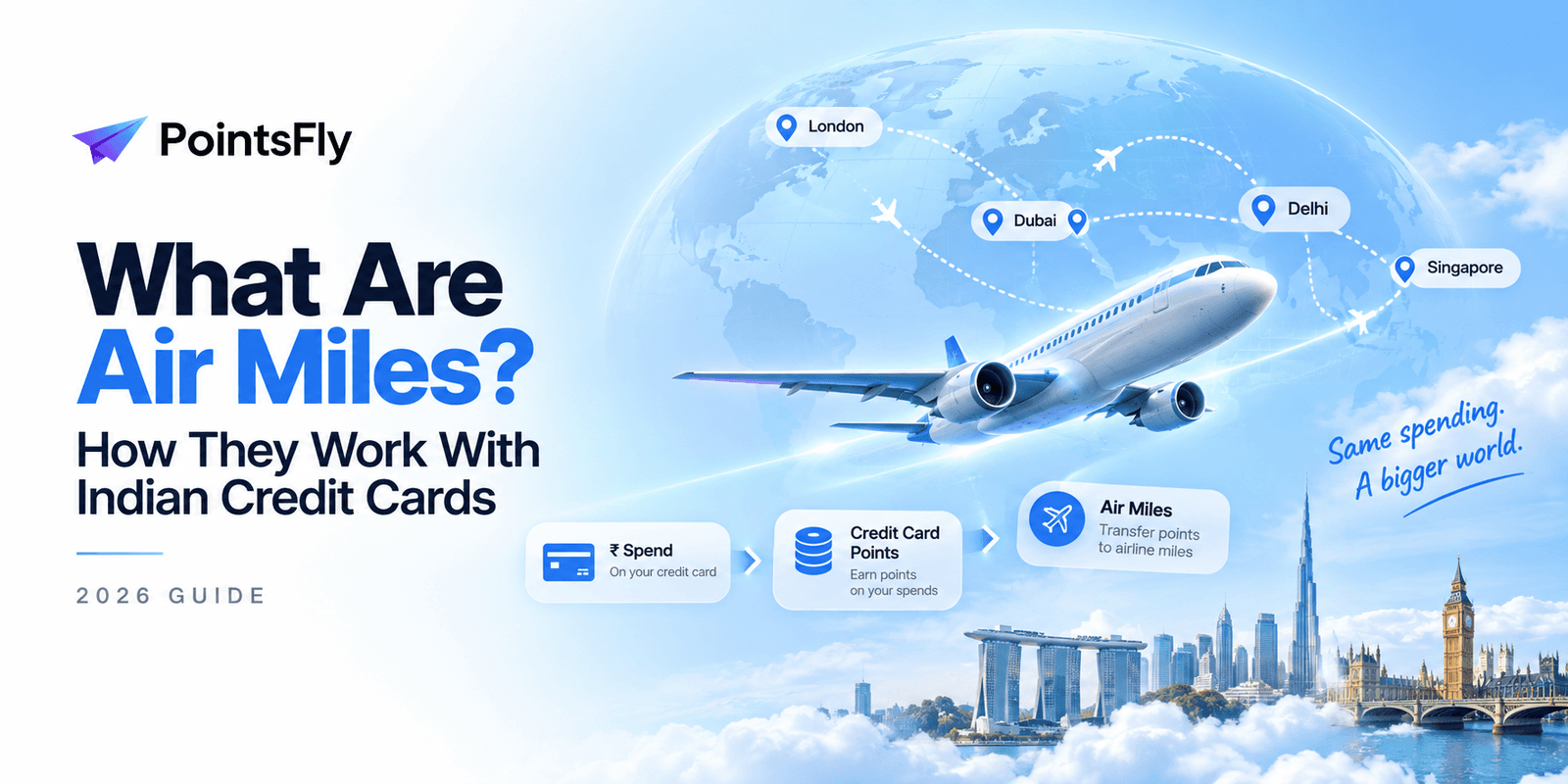
Here is the short version, and then we will go properly into it: your bank gives you points. An airline gives you miles. A transfer is the bridge between the two, and it only pays off when you know what waits on the other side.
Quick Answer
What Are Air Miles?
Air miles are the loyalty currency of an airline’s frequent flyer programme, such as Air India Maharaja Club, Singapore Airlines KrisFlyer or British Airways Avios. You earn them by flying, by spending on a co-branded card, or by transferring credit card reward points into the programme. You then spend them on award flights and upgrades rather than on cash, vouchers or merchandise.
The name is a hangover from the old days, when programmes really did pay you by distance flown. That is mostly gone now. Airlines hand out miles based on what you paid, not how far you went, so treat the word as a currency name and nothing more. A mile is not a mile.
Key Takeaways
- Air miles live with an airline. Reward points live with your bank. Same idea, different owner, very different rules.
- You cannot earn air miles directly on a normal Indian rewards card. You earn points first, then transfer.
- Transfers are one way and cannot be reversed, so find the award seat before you move anything.
- A mile is worth what the seat it books is worth. On a long international route that can be well above ₹1 a mile; on a cheap domestic hop it rarely is.
- Every programme has its own expiry clock, and KrisFlyer’s runs whether you use the account or not.
Table of Contents
- Air Miles vs Credit Card Reward Points: What Is Actually Different
- How Do Air Miles Work in India?
- How Credit Card Points Turn Into Air Miles
- The Airline Programmes Indian Cardholders Actually Use
- Person A vs Person B: Same 50,000 Points, Two Very Different Answers
- When Miles Are Worth It, and When Points Are the Smarter Call
- Do Air Miles Expire?
- FAQs
Air Miles vs Credit Card Reward Points: What Is Actually Different
Both are loyalty currency. The difference is who issues them and what you are allowed to do with them.
Credit card reward points are issued by your bank and sit in your bank’s rewards account. HDFC, Axis, Amex, SBI, ICICI and the rest all run their own. You earn them on eligible spends, and you can usually take them as cashback, vouchers, products, a flight booked through the bank, or a transfer out to a travel programme. If you want the full picture on this side, our beginner’s guide on what credit card reward points are really worth covers it properly.
Air miles are issued by an airline and sit in your frequent flyer account. They mostly buy one thing: travel on that airline or its partners. Fewer options, but the good redemptions pay far better than anything on the bank side.
Three practical differences worth holding on to:
- Flexibility. Points can still become almost anything. Miles have already picked a lane. That is why points are worth keeping as points until you have a booking in mind.
- Ceiling. A point redeemed for cashback on a premium card often pays ₹0.20 to ₹0.30. The same point sent to an airline and spent on the right seat can pay several times that.
- Direction. Points go to miles. Miles never come back. Once the transfer lands, that decision is made.
A confusing detail, and one worth naming: some Indian cards call their own bank currency “miles”. Axis Atlas earns EDGE Miles. Those are Axis currency, not airline currency, and they still have to be transferred before an airline will recognise them. If a balance is showing inside your bank app, it is points, whatever the label says.
How Do Air Miles Work in India?
There are three ways miles land in an airline account.
You fly. Credit your ticket to the airline’s programme and it pays you miles based on fare and cabin. Air India credits Maharaja Points; IndiGo credits BluChips; international carriers credit their own currency.
You spend on a co-branded card. Cards tied to a single airline push their currency straight into that programme. Simple, but it locks your earning to one airline.
You transfer bank points across. This is how most Indian cardholders actually build a meaningful mile balance, and it is the route worth understanding in detail.
What Is One Air Mile Actually Worth?
There is no fixed rate, and anyone quoting one is guessing. A mile is worth whatever the seat it books would have cost in cash, divided by the miles it took.
Take a route we have actually priced. Singapore Airlines wants 19,000 KrisFlyer miles for a Saver economy one way out of India. We went looking for the cash fare in September, and the nonstop Delhi to Singapore flight on 18 November 2026 came up at ₹24,243. Divide one by the other and each mile did about ₹1.28 of work. You still pay the taxes in cash.
Now run the same sum on a ₹4,000 domestic hop that costs 5,000 miles. You get ₹0.80. Same miles, barely half the value, and nothing about the miles changed. The cash fare was just low to start with.
At PointsFly we grade redemptions on a simple scale:
- Poor: under ₹0.50 a point or mile
- Average: ₹0.50 to ₹1
- Good: ₹1 to ₹2
- Excellent: over ₹2
Miles earn their reputation on long international routes and premium cabins, where cash fares are high and award prices are not. On short domestic economy, they usually land in “average” at best.
How Credit Card Points Turn Into Air Miles
The mechanics are the same at every bank. You pick an airline from your bank’s partner list, choose how many points to move, and confirm. The points leave your bank account and arrive as miles a few working days later. HDFC, for instance, asks for 5 to 7 working days for the airline to confirm, so this is not a same-day plan.
Transfer Ratios, and Why 1:1 Is Not Automatically the Best Deal
A transfer ratio tells you how many bank points buy how many airline miles.
- 1:1 means 10,000 points become 10,000 miles
- 2:1 means 20,000 points become 10,000 miles
- 5:2 means 50,000 points become 20,000 miles
The instinct is to chase 1:1. That instinct is often wrong, because the ratio only tells you half the story. What matters is how many miles the seat you want actually costs in the destination programme.
A 1:1 transfer into a programme that wants 100,000 miles for your route is worse than a 5:2 transfer into one that wants 30,000. Always price the award first, then work backwards to the ratio.
Which Indian Cards Can Transfer to Airlines?
Transfers are largely a premium card feature, and the partner lists move around more than most people expect.
HDFC Infinia and Diners Club Black are the ones with real reach here. Both pay 5 points for every ₹150 you spend, and the partner list is long. As of September 2026 it splits into two groups.
- At 1 point to 1 mile: Singapore Airlines KrisFlyer, Air France-KLM Flying Blue, Finnair Plus, Vietnam Airlines Lotusmiles, SpiceJet SpiceClub and AirAsia Rewards.
- At 2 points to 1 mile: Air India Maharaja Club, British Airways Executive Club, Qatar Airways Privilege Club, Cathay Asia Miles, Air Canada Aeroplan, Etihad Guest, Thai Royal Orchid Plus, United MileagePlus, Turkish Miles&Smiles and Avianca LifeMiles.
Our guide to redeeming HDFC credit card points walks through all of it, including the hotel partners.
Axis Atlas earns EDGE Miles and transfers to a long partner list, though Axis reworked its Travel Edge programme from 2 April 2026 and Accor has since left. The standard Atlas ratio is 1 EDGE Mile to 2 partner miles, inverted for a few partners, so check yours before moving anything.
Axis Magnus sits on the other side of the same programme and converts 5 EDGE points to 2 miles with most partners, which is a meaningful step down. Our Axis Magnus review has the full picture after the devaluation.
American Express Membership Rewards cards in India typically earn 1 point per ₹50 and transfer to a small set of airline and hotel partners.
HSBC, SBI and a few others run their own partner lists, usually shorter.
If your card is not on a list like this, that is genuinely fine. Your best value is a well chosen travel redemption inside your bank’s own ecosystem, and you can stop worrying about miles altogether.
Partner lists and ratios are correct as of September 2026 and banks do change them. Confirm in your bank’s NetBanking or rewards portal before you transfer.
The Airline Programmes Indian Cardholders Actually Use
Air India Maharaja Club is the home programme for most Indians, and Air India’s Star Alliance membership is the reason it punches above its weight. Star Alliance has 26 member airlines, so Maharaja Points can put you on 25 other carriers when award seats open up.
Singapore Airlines KrisFlyer is the transfer destination most Indian cardholders end up using, partly because so many cards reach it 1:1 and partly because the Southeast Asia routes price well. KrisFlyer’s Star Alliance partner chart, for example, asks 35,000 miles for an economy round trip between Central and South Asia and Southeast Asia, which is 17,500 one way.
Avios is the shared currency behind British Airways Executive Club, Qatar Airways Privilege Club, Iberia and Finnair, and balances can be moved between them. Useful reach for a single currency.
Air France-KLM Flying Blue is worth knowing for Europe, and it runs regular Promo Rewards that cut award prices on selected routes.
IndiGo BluChip is the domestic outlier. It earns up to 16 BluChips per ₹100 on IndiGo flights, stays inside IndiGo’s own ecosystem, and has no transfer partners to research. Less upside, far less homework.
Person A vs Person B: Same 50,000 Points, Two Very Different Answers
Two cardholders, both holding an HDFC Infinia, both sitting on 50,000 points.
Person A takes cashback. At up to ₹0.30 a point, that is ₹15,000 off the next statement. Quick, certain, done in two taps.
Person B moves all 50,000 to KrisFlyer at 1:1. Two Saver economy one ways between India and Singapore cost 38,000 miles together. At the ₹24,243 fare we checked, those two seats were worth about ₹48,486 in cash, which is roughly ₹1.28 a mile, and 12,000 miles are still sitting in the account.
Person A got “poor” value on our scale. Person B got “good”, plus a leftover balance. Same card, same balance, same month. The only thing that changed was where the points went.
Two honest caveats. Person B had to find two award seats on the dates they wanted, and award prices and cash fares both move around. That is the work miles ask of you, and it is exactly why so many people skip it.
Not sure what your points are worth right now?
Run your balance through our free calculator before you redeem anything.
When Miles Are Worth It, and When Points Are the Smarter Call
Miles are the better answer when most of these are true:
- You are booking international, ideally long haul, and ideally premium economy or business
- The cash fare is high enough that a saved fare is real money
- You hold a card that reaches a strong programme at a decent ratio
- You have 3 to 6 months of planning room, because award seats open and close
- You have found the seat already, before transferring
Points are the better answer when:
- Your card has no airline partners, which is true of most mid-range Indian cards
- You are flying domestic economy, where cash fares are low and the maths flattens out
- You want the value soon and cannot wait on award availability
- You would rather keep one balance than track expiry in two places
- You want the option to use it on a hotel instead, which points keep open and miles do not
There is no universal winner here. There is only what your card can reach and what you are trying to book.
Do Air Miles Expire?
Yes, and the rules differ enough to matter.
- KrisFlyer miles expire three years from the end of the month they were earned. Using the account does not push that date back, which catches people out. Singapore Airlines allows one paid extension of 6 months, and once miles have expired they cannot be extended.
- Avios expire if you have not collected or spent any Avios for 36 months. Any activity restarts the clock.
- Air India Maharaja Points expire after 36 months of no activity, per the programme’s terms as of September 2026.
- IndiGo BluChips stay valid as long as you remain programme active, which means activity within the last 24 months.
The practical takeaway: bank points usually give you a longer, calmer runway than airline miles do. Transferring early “so the miles are ready” starts a clock you did not need to start. Book first, then transfer.
The Easier Way to Use Your Miles
Earning is the easy half. The hard half is working out which programme to send your points to, how many miles your route costs there, whether a partner airline prices it cheaper, and whether any of it beats simply booking with cash.
That is a lot of tabs, and it is why most people click cashback and move on.
That is the gap PointsFly closes. We find the best points deal across loyalty programmes and their partner airlines, walk you through the transfer from your card to the right programme, and point you to the right site to book. You see the real numbers before you commit anything. Have a look at how it works for flights on credit card points and hotel stays on reward points.
Ready to see what your miles could actually book?
We find the best points deal across loyalty programmes and their partner airlines, walk you through the transfer, and send you to the right site to book.