
Credit Card Basics14 min read
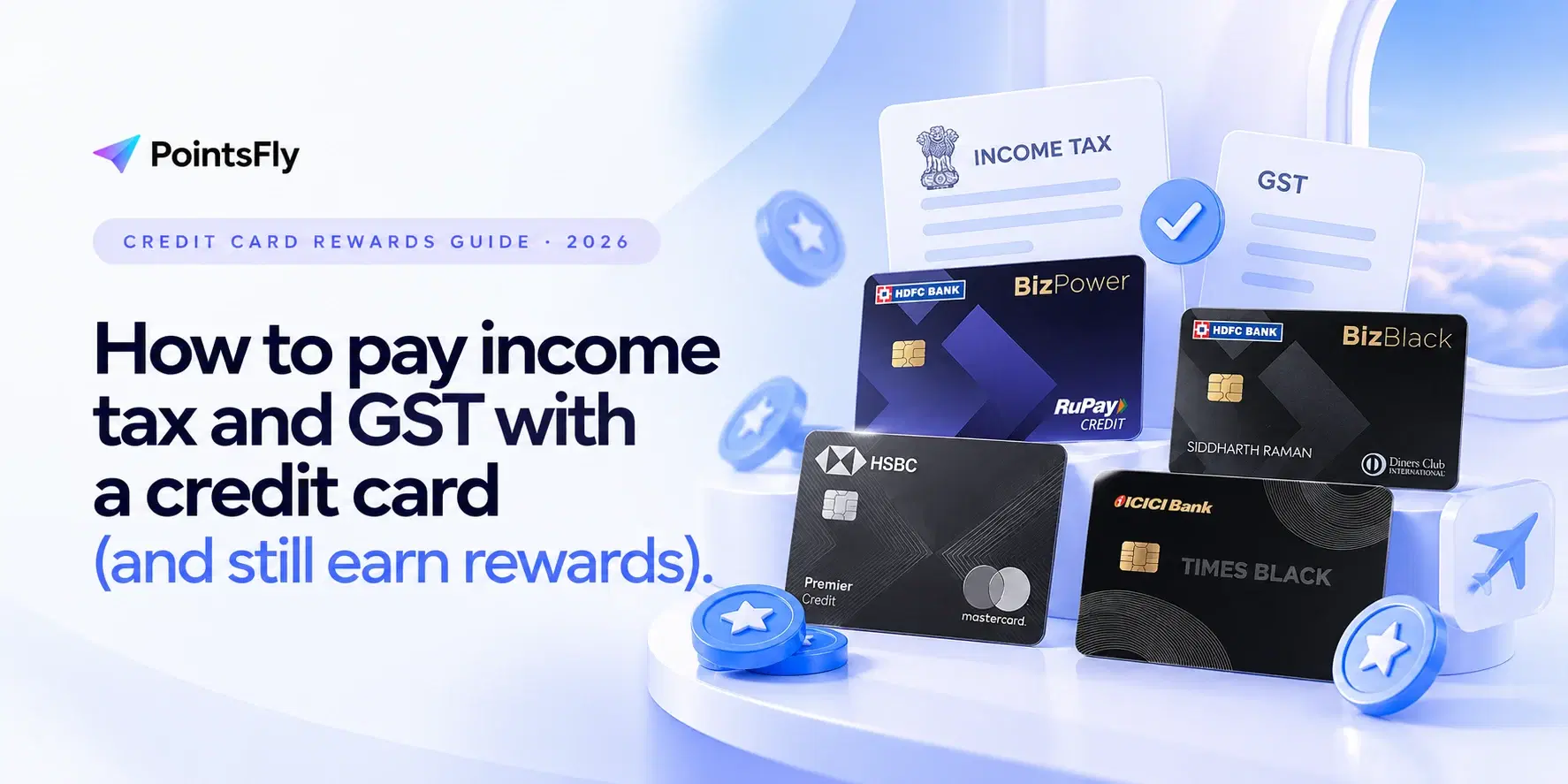
Checked against the Income Tax Department and GST portal payment pages, October 2026.
Yes, you can pay income tax and GST with a credit card in India, right on the official portals. Most people don’t know it, and the ones who do often skip it because of the fee.
That fee is small, though, usually around 1% once you add GST on top. So the real question isn’t whether you can pay tax by card. It’s whether your card gives you more back than you pay to use it. For a few cards, the answer is a clear yes, and the rewards on one big tax payment can cover a flight. Here’s how it all works.
 Quick Answer
Can I pay income tax with a credit card?
Yes. On the income tax e-Filing portal, go to e-Pay Tax, create the challan and pick Payment Gateway, then pay by credit card. For GST, create a challan on the GST portal and choose Credit Card under e-Payment. You’ll pay a fee of about 0.7% to 1% plus GST, so it’s only worth it if your card’s rewards beat that.
Key takeaways
 You can pay both income tax and GST by credit card on the government portals, through a bank’s payment gateway.
 The fee is about 0.7% to 1% of the tax, plus 18% GST on the fee. On ₹1 lakh, that’s roughly ₹1,000.
 Plenty of cards earn nothing on tax, including HDFC Infinia, SBI Cashback and Axis ACE. Check yours before you pay.
 It’s worth it only when your rewards beat the fee. Cards like HDFC BizPower can give back 5% or more after the fee.
 Pay the card bill in full. Card interest wipes out any reward in a matter of days.
Table of contents
- How to pay income tax
- How to pay GST
- Charges
- Is it worth it?
- Cards that reward tax
- BizPower example
- Mistakes to avoid
- Let PointsFly do the tracking
- Cite this data
- FAQs
How to pay income tax with a credit card
You pay income tax by credit card through the e-Pay Tax service on the income tax e-Filing portal. The card payment goes through a bank’s payment gateway, and the tax lands with the government the same way it would through net banking.
- Open e-Pay Tax. Log in to the e-Filing portal and go to e-File, then e-Pay Tax, then New Payment. You can also use e-Pay Tax without logging in, with your PAN and an OTP.
- Pick the tax. Choose income tax, the assessment year and the type of payment, like advance tax or self-assessment tax.
- Fill in the amount. Enter the tax breakup and continue.
- Choose Payment Gateway. This is the option that takes credit cards. Pick one of the banks listed.
- Pay by card. Check the preview, click Pay Now, accept the terms and you’ll go to the bank’s page. Enter your card details there.
- Save your challan. You’ll get an email and SMS. The challan receipt shows up under Payment History on the e-Pay Tax page.
Advance tax and self-assessment tax
Both work the same way. Advance tax is the one you pay in instalments during the year, and self-assessment tax is what’s left to pay when you file. Just pick the right type in step 2, because that’s how your payment gets matched to your return.
Can you pay TDS with a credit card?
TDS challans are also made on e-Pay Tax, using your TAN. The Payment Gateway option generally shows up there too, but it’s worth checking on the portal before you plan around it.
How to pay GST with a credit card
You can pay GST by credit card on the GST portal, the same way you’d pay by net banking. It works with Visa, Mastercard and RuPay credit cards issued by Indian banks.
- Log in to the GST portal and go to Services, then Payments, then Create Challan.
- Fill in the challan with the tax amounts, then choose E-Payment.
- Select Credit Card as the payment mode and pick a bank gateway. Kotak, HDFC, ICICI, Axis and others offer one.
- Accept the terms and click Make Payment. Enter your card details on the bank’s page and confirm with the OTP.
- Download the challan receipt once the payment goes through.
There’s no separate step to register your card. A couple of limits to know, though: American Express cards usually don’t work here, and the card option was added state by state, so if you don’t see it, your state may not have it yet.
Charges for paying tax with a credit card
Paying income tax or GST by credit card costs about 0.7% to 1% of the amount, plus 18% GST on that fee. The exact rate depends on the bank gateway you pick, and the portal shows it before you pay.
| Portal | What you pay by credit card | GST on the fee | Cost on ₹1 lakh |
|---|---|---|---|
| Income tax (e-Pay Tax) | About 0.72% to 1%, depending on the bank | 18% | About ₹850 to ₹1,180 |
| GST portal | About 0.72% to 0.80%, depending on the bank | 18% | About ₹850 to ₹945 |
| Either portal, by UPI or RuPay debit card | Nothing | None | ₹0 |
So on ₹1 lakh of tax at a 0.85% fee, you’d pay ₹850 plus ₹153 of GST. Call it ₹1,003 all in.
One thing that confuses people: “GST on credit card” usually means the 18% GST that banks charge on card fees and interest. That’s a different thing from paying your business GST with a card.
Is it worth paying taxes with a credit card?
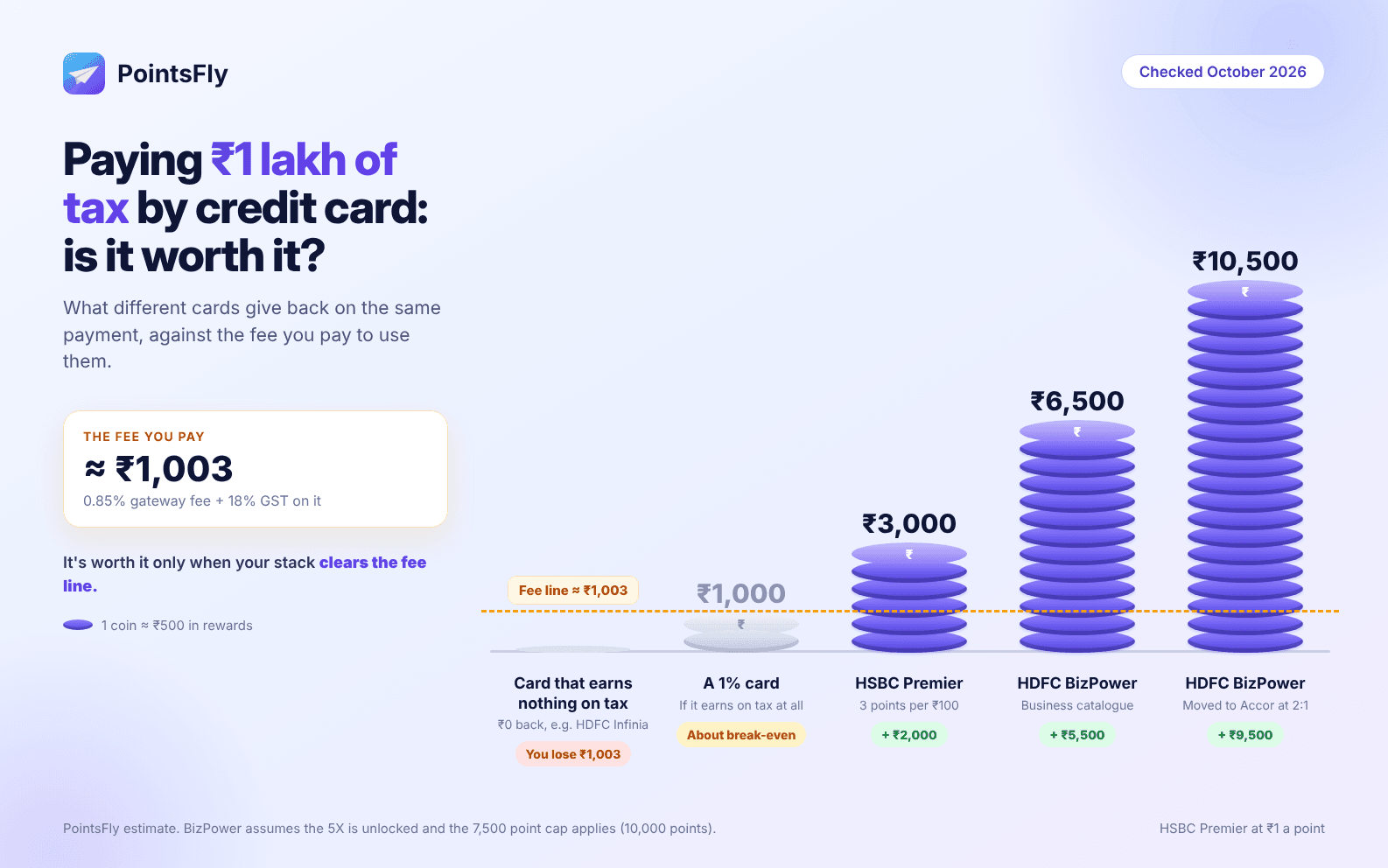
It’s worth paying tax by credit card when your rewards on the payment are worth more than the fee. If they aren’t, you’re paying extra for nothing, and UPI is the better choice.
Here’s the simple way to check:
What you gain = (points earned × value per point) − fee
Take ₹1 lakh of tax. A card that earns nothing on tax leaves you ₹1,003 down. A 1% card barely breaks even. But a card that earns well on tax, like HDFC BizPower, can give you ₹6,500 or more in rewards for that same ₹1,003.
There’s a second perk, too. Most cards give you up to about 50 days before the bill is due, and HDFC’s business cards go up to 55. For a business, that’s useful breathing room around a big GST or advance tax payment.
Just don’t let it turn into a loan, though. If you can’t pay the card bill in full, card interest of around 3.5% a month will cost far more than any reward you earn.
Want to see which of your cards earns the most on tax?
Try our free Reward Points Calculator and compare your cards before you transfer a single point.
Which credit cards still reward tax payments?
The best credit card for tax payment is one that earns full rewards on tax and GST, with points worth more than the fee. Most cards don’t manage that. These ones do.
| Card | What you earn on tax and GST | Things to watch |
|---|---|---|
| HDFC BizPower | 25 points per ₹200 (5X) | Spend ₹25,000 on other things in the cycle first. Only the first 2 income tax and first 2 GST payments earn. Accelerated points capped at 7,500 a cycle |
| HDFC Biz Black | 25 points per ₹150 (5X) | You need to spend more than ₹50,000 in the statement cycle. Accelerated points capped at 7,500 a cycle |
| HSBC Premier | 3 points per ₹100 | Tax shares a ₹1 lakh monthly cap with utilities, rent, insurance and government spends |
| ICICI Times Black | 2% back in reward points | Government payments, including advance tax, share a 5,000 point cycle cap with utilities, insurance and education |
And a few popular cards that earn nothing on tax or government payments: HDFC Infinia, HDFC Millennia, Axis ACE and, since April 2026, SBI Cashback. Banks change these rules often, so it’s worth a quick look at your card’s terms before a big payment.
Worked example: paying GST with HDFC BizPower
Here’s what a ₹1 lakh GST payment looks like on BizPower, the business card we’ve covered in our HDFC Biz Power credit card guide.
Say you’ve already spent ₹25,000 on other things this cycle, so the 5X is on. Then you pay ₹1 lakh of GST in one go.
- At 5X, that would be 12,500 points. But the extra (accelerated) points are capped at 7,500 a cycle.
- So you get 2,500 base points plus 7,500 accelerated points. That’s 10,000 points.
- In HDFC’s business catalogue, at ₹0.65 a point, that’s ₹6,500.
- Transfer them to Accor at 2:1 instead, and they’re worth about ₹10,500.
One small catch with Accor: 10,000 BizPower points become 5,000 Accor points, and Accor takes points off in blocks of 2,000. So top up with another 1,000 Accor points to use them all, or use 4,000 now and keep the rest for your next stay.
Take off the ₹1,003 fee and you’re left with about ₹5,500 in the catalogue, or roughly ₹9,500 at Accor. That’s a return of 5.5% to 9.5% on money your business was paying anyway.
Two things keep it working. Pay in one or two big payments, not lots of small ones, because only the first 2 income tax and first 2 GST payments in a cycle earn points. And if you have other 5X spends that cycle, like Google Ads, they count towards the same 7,500 cap. Our guide to HDFC BizPower transfer partners shows where those points go furthest.
Mistakes to avoid
- Splitting tax into many small payments. On cards like BizPower, only the first two of each kind earn points.
- Assuming your card earns on tax. Many don’t. A quick look at the terms saves you a ₹1,000 fee for nothing.
- Paying on the last day. Gateways can be slow or fail near deadlines. Pay a few days early so you’re not hit with interest from the tax department.
- Not saving the challan. It’s your proof of payment. Download it right away.
- Carrying a balance. If you can’t clear the card bill in full, pay tax by UPI instead.
Let PointsFly do the tracking
Fees, caps, unlock spends and rules about which payment counts. It’s a lot to keep straight just to pay your tax the smart way.
PointsFly keeps track of it for you. It knows what your points are worth on every card you hold. When a big payment comes up, it shows you which card earns the most, and where to use the points afterwards.
Ready to see what your tax payments could earn?
Start your free PointsFly trial and find the best way to use every point you have.
Download the PointsFly app
Track every card, see what your points are worth, and get the best flight and hotel deals for them. 7 days free.


Read next: our HDFC Biz Power credit card guide, the HDFC BizPower transfer partners ranked by value, and our beginner’s guide to what credit card reward points are worth.
Cite this data
Writing about paying tax by credit card? Feel free to use our numbers.
Payment steps and gateway charges come from the Income Tax Department’s e-Pay Tax help pages and bank gateway charge pages for GST, checked on 28 October 2026. Card earn rates come from each bank’s terms and published card reviews, checked in October 2026.
Something like this works: “PointsFly estimates that paying ₹1 lakh of tax by credit card costs about ₹1,000 in fees, while a card like HDFC BizPower can earn ₹6,500 or more in rewards on the same payment.”
All we ask is a link back. We update these numbers when the portals or banks change their fees and rules.
FAQs
About the author
 Vibhav Singh is the Founder & CEO of PointsFly and a credit card rewards strategist with 39K+ Instagram followers (@pointsflywithvibhav). He has personally booked 200+ flights on points and previously built XTEN-AV, an AI-powered SaaS platform now used in 130+ countries.