
Know Your Cards21 min read
Checked against bank product pages, fee schedules and card terms, 2 November 2026.
India now has more than 20 metal credit cards. Some are invite-only, like HDFC Infinia and ICICI Emeralde Private Metal. Others you can apply for today, and a couple cost nothing at all. They all feel the same in your hand: heavier, cooler and a lot more solid than plastic.
Here’s the thing, though. The metal doesn’t earn you a single point. What you actually get from a metal credit card comes down to three things: the rewards, the fee and whether the bank will give you the card. So that’s how we’ve compared them. Below you’ll find all 13 of the best metal cards in India side by side, what each one gives back on every ₹100, and which one fits the way you spend.
 Quick Answer
What is the best metal credit card in India?
For rewards, HDFC Infinia Metal and ICICI Emeralde Private Metal lead, at about 3% back, but both are invite-only. If you want a metal card you can apply for today, HDFC Diners Club Black Metal gives the same 3.33% for a ₹10,000 fee. On a budget, PNB Luxura’s Visa variant costs ₹1,999 a year.
Key takeaways
Metal doesn’t mean more rewards. Returns run from about 0.2% on OneCard to 3.33% on Infinia and Diners Black. The fee and the earn rate matter far more than the material.
The best ones are invite-only. Infinia, Emeralde Private Metal and Axis Reserve usually come by invitation, and HSBC Premier needs a Premier account.
You can still get a strong one without an invite. Diners Club Black Metal, Axis Magnus and ICICI Times Black all take applications, and each one waives the fee if you spend enough.
Cheap metal cards exist. PNB Luxura (Visa) is ₹1,999 a year, AU Zenith+ is ₹4,999, and AU’s CA Metal card is free for chartered accountants.
Check before you apply. Amex has paused new card applications in India, and OneCard’s new issuance has been on hold since December 2025.
Table of contents
- What a metal card is
- All 13 cards compared
- Super-premium cards
- Mid-range cards
- Low-fee and free cards
- Other metal cards
- Which one is best for you
- How to get one
- Is it worth it?
- Cite this data
- FAQs
What is a metal credit card?
A metal credit card is exactly what it sounds like: a credit card made of metal, usually stainless steel, instead of plastic. A plastic card weighs about 5 grams, and a metal one is usually two to five times that. IDFC FIRST, for example, says its Mayura weighs 17 grams.
It works the same way as any other card. You can tap it, insert it or swipe it, and it has the usual chip and contactless antenna built in. Banks use metal for their premium cards because it feels special, and because people notice when you put it down on the table.
Metal vs plastic: does it matter?
Only for the feel. A metal card doesn’t get you more rewards, better lounge access or a higher limit than the plastic version of the same card would. Those come from the card itself.
There’s one thing to watch out for. Plenty of shops online will “convert” your plastic card into metal, by moving the chip onto a metal blank. That’s not a bank-issued metal card, it’s a cover, and your bank may not support it. If you want a real metal credit card, it has to come from the bank.
Metal credit cards in India compared
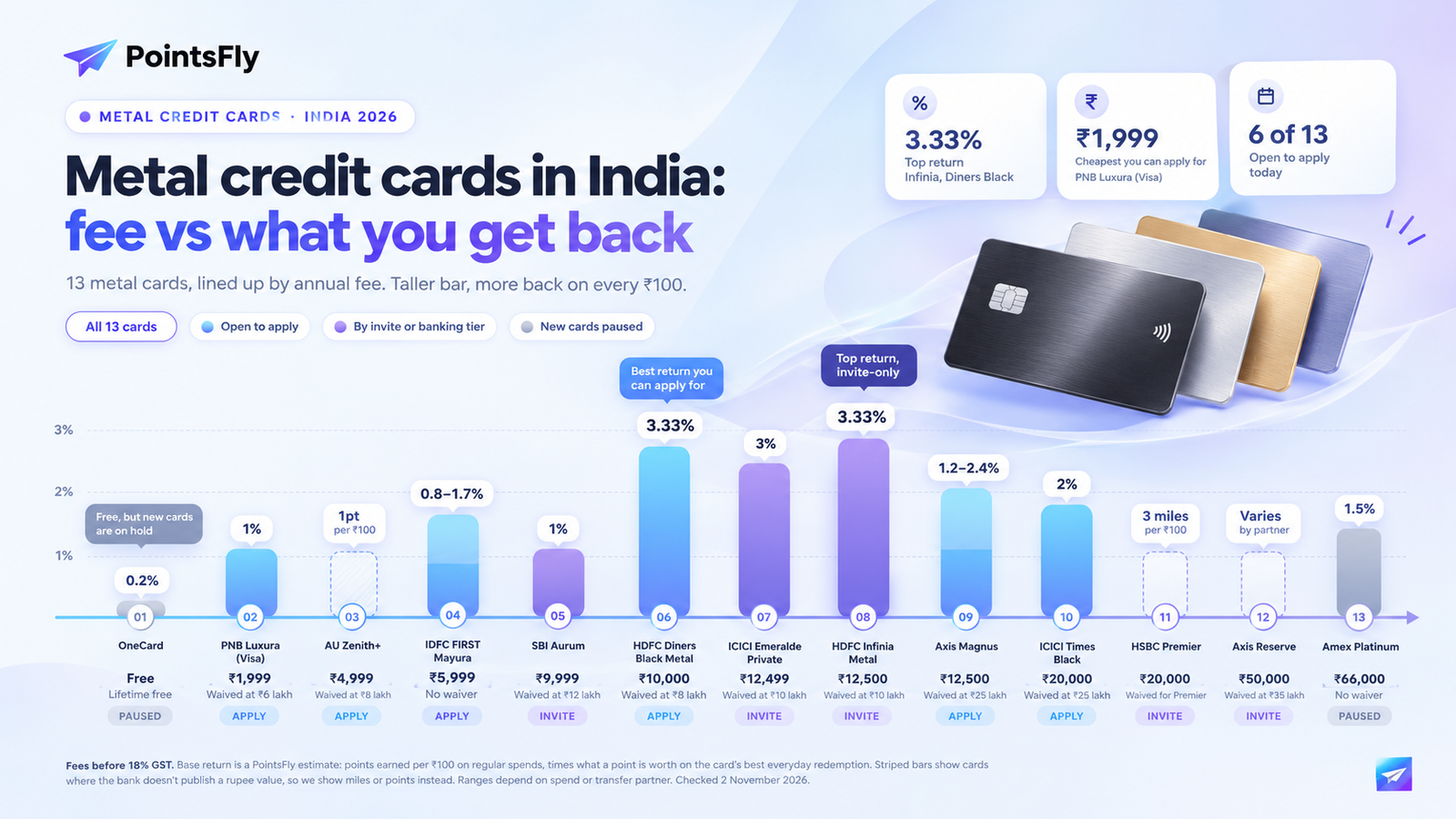
Here are the 13 best metal credit cards in India, side by side. Fees are before 18% GST.
| Card | Annual fee | Fee waived at | Base return | Lounge access | How you get it |
|---|---|---|---|---|---|
| HDFC Infinia Metal | ₹12,500 | ₹10 lakh a year | 3.33% | Unlimited, India and abroad | Invite-only |
| ICICI Emeralde Private Metal | ₹12,499 | ₹10 lakh a year | About 3% | Unlimited, India and abroad | Invite-only |
| ICICI Times Black | ₹20,000 | ₹25 lakh a year | About 2% | Unlimited, India and abroad | Open to apply |
| Axis Magnus | ₹12,500 | ₹25 lakh a year | About 1.2% to 2.4% | Unlimited, India and abroad | Open to apply |
| Axis Reserve | ₹50,000 | ₹35 lakh a year | Varies by partner | Unlimited, India and abroad | Mostly by invite |
| HSBC Premier | ₹20,000 renewal | While you’re an HSBC Premier client | 3 miles per ₹100 | Unlimited, India and abroad | HSBC Premier clients |
| Amex Platinum Charge | ₹66,000 | No waiver | About 1.5% | Global Lounge Collection | Applications paused |
| HDFC Diners Club Black Metal | ₹10,000 | ₹8 lakh a year | 3.33% | Unlimited, India and abroad | Open to apply |
| SBI Aurum | ₹9,999 | ₹12 lakh a year | About 1% | 4 a quarter in India, unlimited abroad | Mostly by invite |
| IDFC FIRST Mayura | ₹5,999 | No waiver | About 0.8% to 1.7% | 4 in India and 4 abroad a quarter | Open to apply |
| PNB Luxura (Visa) | ₹1,999 | ₹6 lakh a year | About 1% | Unlimited, India and abroad | Open to apply |
| AU Zenith+ | ₹4,999 | ₹8 lakh a year | 1 point per ₹100 | 16 in India and 16 abroad a year | Open to apply |
| OneCard | Free | n/a | About 0.2% | None | Issuance paused |
Base return is a PointsFly estimate: points earned per ₹100 on regular spends, times what a point is worth on the card’s best everyday redemption.
Super-premium metal credit cards
These are the heavyweights: high fees, big rewards and, for most of them, an invitation from the bank.
HDFC Infinia Metal
HDFC Infinia is the card most people think of first, and for good reason. It earns 5 reward points per ₹150, and each point is worth ₹1 on SmartBuy flights and hotels or 1 KrisFlyer mile. That’s 3.33% back on almost everything you spend.
- Fee: ₹12,500, waived at ₹10 lakh a year. You get 12,500 points when you pay it.
- Best for: SmartBuy. Hotels earn 10X and flights 5X, up to 15,000 bonus points a month.
- Lounges: unlimited in India and abroad, for you and your add-on cardholders.
- Getting it: invite-only. From April 2026, HDFC also wants ₹18 lakh of spend a year or ₹50 lakh with the bank, or it may downgrade the card.
The Infinia metal card is the benchmark every other card on this list gets measured against. Our HDFC Infinia guide has the full breakdown.
ICICI Emeralde Private Metal
ICICI’s answer to Infinia. It earns 6 points per ₹200, and a point is worth up to ₹1 on iShop flights and hotels or 1 Air India Maharaja point. That works out to about 3% back.
- Fee: ₹12,499, waived at ₹10 lakh a year, with 12,500 bonus points when you join.
- Best for: iShop, where hotels earn 12X. That’s up to 36% back, with a cap of 18,000 points a month.
- Lounges: unlimited in India and abroad, for you and up to 3 add-on cards.
- Getting it: invite-only, mostly for ICICI Private Banking clients.
Our ICICI Emeralde Private Metal guide covers fees, lounges and the best ways to use your points, and our ICICI iShop guide shows how to get that 36%.
ICICI Times Black
ICICI’s other metal card, built with Times Internet. It earns 2 points per ₹100 in India and 2.5 abroad, and a point is worth up to ₹1, so that’s about 2% back.
- Fee: ₹20,000, waived at ₹25 lakh a year.
- Best for: spending abroad, since you earn 2.5% and the forex markup is a low 1.49%.
- Lounges: unlimited in India and abroad, for you and your add-on cards.
- Getting it: open to apply. ICICI looks for ₹2 lakh a month in salary, or ₹24 lakh a year if you’re self-employed.
Axis Magnus
Axis Magnus is open to apply, which makes it one of the easier high-end metal cards to get. It earns 12 EDGE points per ₹200, and 35 on whatever you spend above ₹1.5 lakh in a month.
Axis shuffled its transfer partners a few times in 2026. Most of them, including KrisFlyer and Air India, still convert at 5:2, but a few, like Accor, Qatar and British Airways, are now 5:1. So a regular spend gets you about 2.4% back on most partners and 1.2% on the rest.
- Fee: ₹12,500, waived at ₹25 lakh a year.
- Best for: big monthly spenders who clear ₹1.5 lakh, and Travel Edge bookings.
- Lounges: unlimited in India and abroad. Since August 2026, domestic lounges work with your card and boarding pass.
- Getting it: open to apply. There’s also a Magnus for Burgundy version for Axis Burgundy clients.
Axis Reserve
Axis’s top metal card. It earns 15 EDGE points per ₹200 in India and 30 per ₹200 abroad, and it comes with up to 50 golf rounds a year, Accor Plus, Club Marriott and Club ITC. From 15 November 2026, you have to opt in to renew those memberships.
- Fee: ₹50,000, waived at ₹35 lakh a year.
- Lounges: unlimited in India and abroad, plus 12 guest visits a year.
- Getting it: mostly by invitation, though Axis also has a form to express interest.
Reserve uses the same partner list as Magnus. Accor, Cathay, Qatar and British Airways are 5:1, and most others are 5:2, so check your favourite partner before you count on the points.
HSBC Premier
HSBC Premier earns 3 points per ₹100, and most of its airline partners convert them one to one. That’s 3 miles for every ₹100 you spend, and the forex markup is a low 0.99%.
- Fee: ₹12,000 to join and ₹20,000 a year, with the renewal fee waived while you stay an HSBC Premier client.
- Best for: 20 transfer partners, and spending abroad.
- Lounges: unlimited in India and abroad, plus 8 international guest visits a year.
- Getting it: only for HSBC Premier clients. Premier accounts opened from January 2026 need ₹50 lakh with HSBC.
Our HSBC Premier guide covers the transfer partners in detail.
Amex Platinum Charge
The American Express metal card in India is the Platinum Charge. It’s more about status and hotels than points: Marriott Bonvoy Gold, Hilton Gold, Taj Epicure and the Global Lounge Collection. It earns 1 Membership Rewards point per ₹40, which works out to about 1.5% back.
- Fee: ₹66,000, with no waiver.
- Lounges: Global Lounge Collection, including Priority Pass.
- Getting it: Amex says it’s temporarily not accepting new card applications in India. Check its site before you plan around this one.
Mid-range metal credit cards
Strong cards with fees of ₹10,000 or less, and most of them are open to apply.
HDFC Diners Club Black Metal
If you can’t get Infinia, this is the closest thing. Diners Black Metal earns the same 5 points per ₹150, at ₹1 a point on SmartBuy. That’s 3.33% back for a lower fee, and anyone who meets the income bar can apply.
- Fee: ₹10,000, waived at ₹8 lakh a year.
- Best for: SmartBuy hotels (10X), plus Club Marriott, Amazon Prime and Swiggy One when you spend ₹1.5 lakh in your first 90 days.
- Lounges: unlimited in India and abroad, through the Diners Club network.
- Getting it: open to apply. HDFC looks for ₹1.75 lakh a month in take-home salary, or ₹21 lakh a year in ITR if you’re self-employed.
Torn between the two HDFC metal cards? Our Infinia vs Diners Black comparison runs the numbers.
SBI Aurum
SBI’s metal card earns 4 points per ₹100, and points are worth about ₹0.25 each, so roughly 1% back. Its real value is in the extras.
- Fee: ₹9,999, waived at ₹12 lakh a year.
- Best for: milestone vouchers (Tata CliQ, Taj, Apple), Club Marriott, ₹1,000 a month on BookMyShow and 16 golf rounds a year.
- Lounges: 4 a quarter in India, and unlimited abroad through DreamFolks.
- Getting it: mostly by invitation, although SBI’s site also lets you express interest.
IDFC FIRST Mayura
The metal card for people who travel abroad. Mayura has zero forex markup, so you don’t lose 2% to 3.5% every time you pay in another currency.
It earns 5X up to ₹20,000 a month and 10X above that, which is about 0.8% to 1.7% back at ₹0.25 a point. Book hotels and flights in IDFC FIRST’s app, though, and you earn up to 40X and 25X, with points worth ₹0.50 there.
- Fee: ₹5,999. There’s no waiver, but you get 7,500 points at ₹8 lakh a year and 15,000 at ₹15 lakh.
- Lounges: 4 in India and 4 abroad each quarter, once you spend ₹20,000 the month before.
- Getting it: open to apply.
IDFC FIRST cut Mayura’s international earn from 10X to 5X in early 2026. It’s still zero forex, though, so it’s a good card to carry abroad.
Low-fee and free metal credit cards
You don’t need a ₹10 lakh spend to carry a metal card. These are the cheapest ways to get one.
PNB Luxura
The PNB Luxura metal credit card is one of the best-value metal cards in India. It comes in two versions.
- Visa Infinite: ₹4,999 to join and ₹1,999 a year. The joining fee goes away at ₹1.5 lakh of spend in 3 cycles, and the annual fee at ₹6 lakh a year.
- RuPay: ₹9,000 to join and ₹7,500 a year, waived at ₹2.5 lakh in 3 cycles and ₹8 lakh a year. It adds a 3-for-2 nights offer at ITC hotels.
Both earn 4 points per ₹100 (about 1% back) and 3X on travel and dining, with zero forex markup and unlimited lounges in India and abroad. You get 20,000 bonus points if you spend ₹50,000 in your first 90 days. One thing to know: from 1 November 2026, PNB charges ₹99 + GST each time you redeem points.
AU Zenith+
AU’s metal card is open to apply and costs ₹4,999 a year, waived at ₹8 lakh. It earns 1 point per ₹100 and 2 per ₹100 on dining, travel and international spends. AU values each point at ₹1, but vouchers and statement credit work out to about ₹0.20 to ₹0.25 a point, and each redemption costs ₹99 + GST.
- Lounges: 16 in India and 16 abroad each year.
- Extras: 8 golf games a year, Taj Epicure at ₹12 lakh of spend and a 0.99% forex markup.
OneCard
OneCard is the only lifetime-free metal credit card most people have heard of. It has no joining or annual fee, and it earns 5X on your top two spend categories each month.
The catch is that rewards are small, about 0.2% on regular spends, and there are no lounges. More importantly, RBI asked OneCard’s partner banks to pause new cards in December 2025, and we couldn’t find any sign the pause has been lifted. If you want one, check the app before you count on it.
Other metal credit cards in India
These are metal too, but they’re either niche, invite-only for a small group, or built for one kind of customer.
| Card | Annual fee | Who it’s for | Stand-out feature |
|---|---|---|---|
| AU CA Metal | Free | Chartered accountants (ICAI members) | 8 points per ₹100 on travel, dining, tax and software |
| IDFC FIRST Ashva | ₹2,999 | Anyone | Zero forex markup |
| IDFC FIRST Gaj | ₹12,500, waived at ₹10 lakh | IDFC Private Banking (invite) | Zero forex, ₹1 a point on app travel |
| IDFC FIRST Private | ₹25,000 (₹50,000 to join) | Invite-only | 10 points per ₹150 |
| Kotak White Reserve | ₹12,500, waived at ₹10 lakh | By invite, through your RM | Also comes on RuPay |
| Kotak Solitaire | Nil for Solitaire clients | Invite-only | Unlimited lounges, add-ons in metal too |
| DBS Vantage | ₹20,000 | DBS Treasures and others | Unlimited lounges |
| YES Bank BYOC (metal) | ₹3,499 | Anyone | You pick your own offers |
| HDFC Biz Black Metal | ₹10,000, waived at ₹7.5 lakh | Business owners | 5X on tax and GST in months you spend ₹50,000 |
Which metal credit card is best for you?
The best metal credit card is the one whose rewards cover its fee at the way you spend. Here’s a simple way to narrow it down.
- You spend ₹10 lakh or more a year and want points: HDFC Infinia or ICICI Emeralde Private Metal, if you can get an invite. HSBC Premier if you bank with HSBC.
- You want a strong card you can apply for today: HDFC Diners Club Black Metal, then Axis Magnus if you spend over ₹1.5 lakh a month.
- You travel abroad a lot: IDFC FIRST Mayura or PNB Luxura (both zero forex), or HSBC Premier at 0.99%.
- You want the lowest fee: PNB Luxura on Visa at ₹1,999 a year.
- You’re a chartered accountant: AU CA Metal, which is free.
Here’s what the choice does to your rewards. Take two people who each spend ₹10 lakh a year.
Person A picks SBI Aurum. At about 1% back, they earn rewards worth around ₹10,000, and the ₹9,999 fee isn’t waived until ₹12 lakh.
Person B picks HDFC Diners Club Black Metal. At 3.33%, they earn around ₹33,000 in SmartBuy value, and the ₹10,000 fee is waived because they crossed ₹8 lakh.
Same spend, both metal cards, and more than ₹30,000 apart once you count the fee.
How to get a metal credit card in India
It depends on which card you’re after.
For cards you can apply for (Diners Black, Axis Magnus, Times Black, Mayura, PNB Luxura, AU Zenith+), it’s like any other credit card. You’ll need a good credit score, usually 750 or more, and you’ll need to clear the bank’s income bar. For Diners Black, that’s ₹1.75 lakh a month in take-home salary.
For invite-only cards (Infinia, Emeralde Private Metal, Axis Reserve, Kotak White Reserve), the bank comes to you. What usually gets you there:
- Keep a big relationship with the bank: savings, deposits and investments.
- Spend a lot on one of its cards. Heavy spenders on HDFC’s or ICICI’s other cards are often the ones who get the upgrade offer.
- Ask your relationship manager. If you’re close to the bar, they can often push an upgrade.
Is a metal credit card worth it?
Only if the rewards and perks cover the fee. The metal is a nice bonus, not a reason to pay ₹10,000 a year.
A quick check: multiply your yearly spend by the card’s base return and compare it with the fee.
| Yearly spend | Diners Black Metal (3.33%, ₹10,000 fee) | SBI Aurum (1%, ₹9,999 fee) | PNB Luxura Visa (1%, ₹1,999 fee) |
|---|---|---|---|
| ₹5 lakh | ₹16,650 back, fee paid | ₹5,000 back, fee paid | ₹5,000 back, fee paid |
| ₹10 lakh | ₹33,300 back, fee waived | ₹10,000 back, fee paid | ₹10,000 back, fee waived |
| ₹20 lakh | ₹66,600 back, fee waived | ₹20,000 back, fee waived | ₹20,000 back, fee waived |
Lounges, golf and memberships add to that, but only if you’d actually use them.
Let PointsFly do the tracking
Working out which metal card fits your spending, whether you’ll hit the fee waiver this year, and where your points are worth the most takes a lot of maths. Most people pick a card for how it looks and never check.
PointsFly keeps track of it for you. It shows you which card earns the most on each purchase, and when it’s time to redeem, it finds the option that gets you the most for your points.
Ready to see what your cards are really worth?
Start your free PointsFly trial and see how far your rewards can go.
Download the PointsFly app
Track every card, see what your points are worth, and get the best flight and hotel deals for them. 7 days free.


Read next: our ICICI Emeralde Private Metal guide, the HDFC Infinia guide, and how to earn up to 36% back with ICICI iShop.
Cite this data
Writing about metal credit cards in India? Feel free to use our numbers.
Fees, waivers, earn rates, lounge access and eligibility come from each bank’s product page, fee schedule and card terms, read on 2 November 2026, with recent changes checked against bank notices. The base return is a PointsFly estimate: points earned per ₹100 on regular spends, times what a point is worth on the card’s best everyday redemption.
Something like this works: “PointsFly found that metal credit cards in India return anywhere from about 0.2% to 3.33% on regular spends, with HDFC Infinia and Diners Club Black Metal at the top.”
All we ask is a link back. We update these numbers whenever the banks change their cards.
FAQs
About the author
 Vibhav Singh is the Founder & CEO of PointsFly and a credit card rewards strategist with 39K+ Instagram followers (@pointsflywithvibhav). He has personally booked 200+ flights on points and previously built XTEN-AV, an AI-powered SaaS platform now used in 130+ countries.