What the card earns, what it costs, and how much it really gives back at your level of spending.
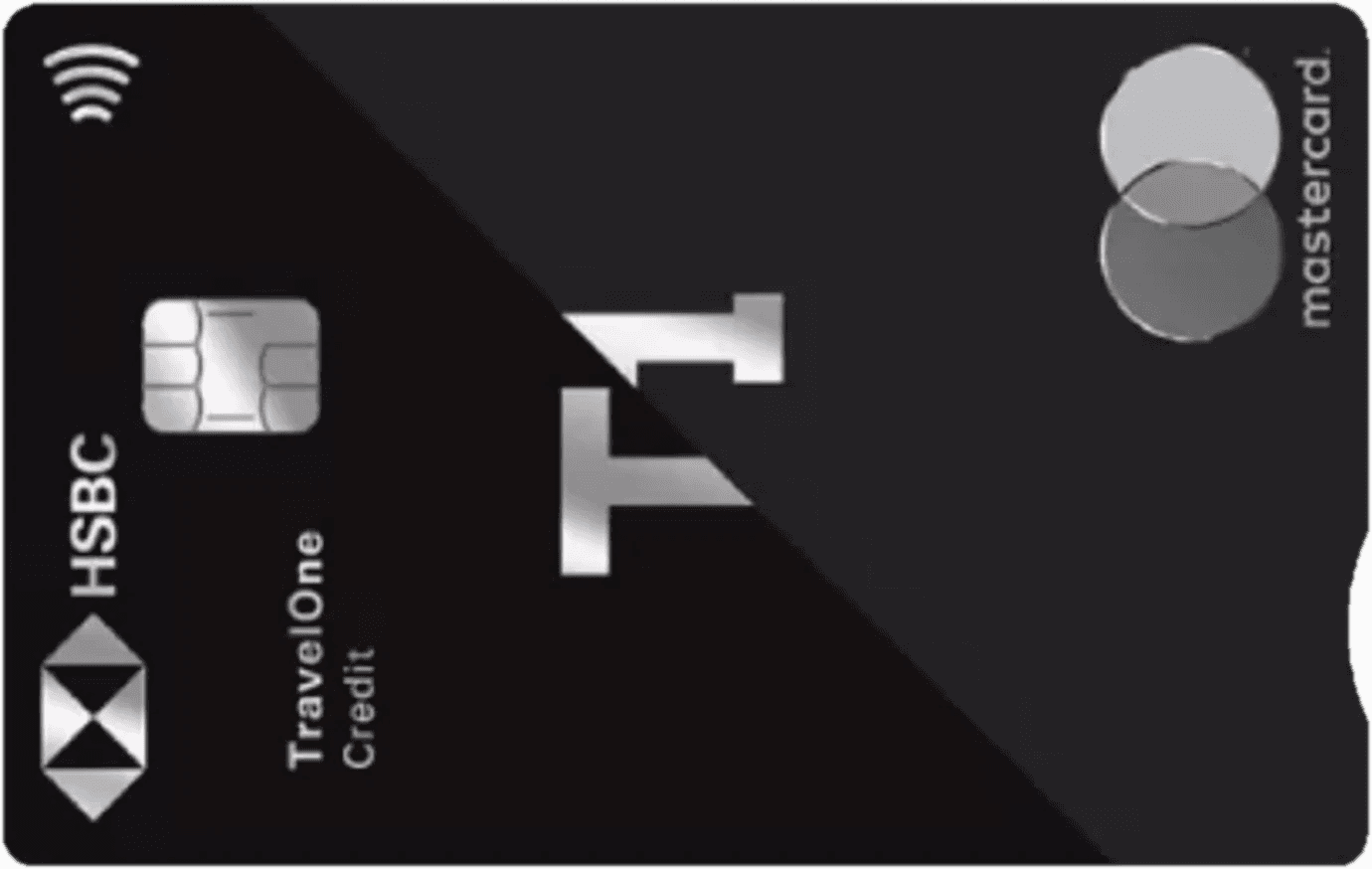
| Annual fee | ₹4,999 + GST, reversed above ₹8 lakh a year |
| Travel and forex earn | 4 reward points per ₹100 |
| Everyday earn | 2 reward points per ₹100 |
| Transfer partners | 20 airlines and hotels, mostly 1:1 |
| Lounges | 6 domestic + 4 international a year |
Card overview
The HSBC Travel One credit card is a ₹4,999 travel card that earns 2 reward points per ₹100 on most spends and 4 per ₹100 on flights, travel sites and foreign currency. You can move those points 1:1 to airlines like Singapore Airlines and Air India, right inside the HSBC app. (HSBC writes the name as TravelOne. Most people search for it as Travel One, so you’ll see both here.)
Here’s what makes it interesting. Unlike a lot of travel cards, Travel One doesn’t care where you book. MakeMyTrip, Cleartrip, the airline’s own site: they all earn 4 points per ₹100. And if you spend more than ₹8 lakh in a year, you don’t pay the renewal fee at all.
Reward point value at a glance
A Travel One point doesn’t have one fixed value. It depends on where you spend it.
~₹2.10 per point
Accor hotels at 1:1 (2,000 points always take €40 off)
~₹1.20 to ₹2 per point
Singapore Airlines KrisFlyer at 1:1, economy to business class
Less than ₹1 per point
HSBC’s Travel with Points. Only Premier and Privé cards get ₹1 a point there
Gift vouchers sit lower, at about ₹0.25 a point. Take 20,000 points. As vouchers, they’re worth about ₹5,000. Moved to Accor, they take €400 off a hotel stay. Same points, but about eight times the value. Our guide to redeeming HSBC reward points breaks down every option.
Where you earn, and where you don’t
Travel and forex rate
4 points per ₹100
Airlines, travel sites like MakeMyTrip and Cleartrip, and anything you pay for in a foreign currency. Up to 50,000 points a month. Book on HSBC’s Travel with Points and it goes up to 6X.
Everyday rate
2 points per ₹100
On almost everything else, with no cap.
Earns nothing
- Fuel and utilities
- Insurance and jewellery
- Wallet loads
- Education, government and tax
- Money transfers
- Real estate agents
Key takeaways
- Travel One costs ₹4,999 + GST a year, and HSBC gives the renewal fee back once you spend more than ₹8 lakh in a card year.
- You earn 4 points per ₹100 on flights, travel sites and foreign spends, and 2 per ₹100 on most other things.
- Spend more than ₹12 lakh in a year and you get 10,000 bonus points on top.
- Points move to 15 airlines and 5 hotel groups, mostly 1:1 and usually within a working day.
- At ₹9 lakh a year, the card gives back about 3% when you move points to KrisFlyer, or 5% or more when you transfer to Accor.
What’s in this guide
HSBC Travel One credit card benefits
The main HSBC Travel One credit card benefits are 4 points per ₹100 on travel and foreign spends, transfers to 20 airline and hotel programmes, most of them 1:1, 10 lounge visits a year and 15% off flights and hotels on travel sites like Cleartrip and Goibibo.
The points are the main event. But the extras add up if you travel a few times a year:
- 15% off on travel sites. Cleartrip, EaseMyTrip and Goibibo give Travel One cardholders 15% off, each with its own promo code. The saving goes up to ₹3,000 on domestic bookings and ₹5,000 on international ones, and you can use each code once or twice a year depending on the site. All three offers run until 31 December 2026. HSBC’s page also lists Yatra and Paytm, but their offer terms ended in December 2025, so check the code at checkout before you count on it.
- Duty free. 20% off at AdaniOne duty free, up to ₹3,000, when you spend ₹8,000 or more. Once a year.
- Stays. 11% off StayVista villas, up to ₹3,000 a booking, twice a year.
- Dining and movies. 10% off at EazyDiner (up to ₹1,000), and buy one, get one movie tickets twice a month on the District app.
- Golf. 4 free rounds and 12 free lessons a year, plus 50% off green fees after that.
- Airport transfers. Through 31 December 2026, primary cardholders also get one free domestic airport transfer a quarter, up to 4 in the year. Your card needs to be at least 45 days old and active, and you book at least 72 hours ahead.
- Purchase protection. Up to ₹16.66 lakh a year (about USD 20,000), and up to ₹2.5 lakh a claim, if something you bought with the card is stolen or accidentally damaged within 180 days of buying it.
Put together, HSBC says the card’s benefits are worth up to ₹1.6 lakh a year. That number assumes you use every single offer. Your real number depends mostly on your points, which is what the rest of this guide is about.
HSBC Travel One credit card fees and charges
The HSBC Travel One costs ₹4,999 + GST to join and the same every year after. If you spend more than ₹8 lakh in a card year, HSBC gives the renewal fee back.
| Charge | What you pay |
|---|---|
| Joining fee | ₹4,999 + GST (about ₹5,899) |
| Annual fee | ₹4,999 + GST, reversed if you spend more than ₹8 lakh in a card year |
| Add-on card | Free |
| Forex markup | 3.5% + GST |
| Travel with Points flight booking fee | ₹300 per person per leg (domestic), ₹700 (international) |
| Interest | 3.75% a month (45% a year) |
| Cash withdrawal | 2.5% of the amount (minimum ₹500) |
| Late payment | 100% of the minimum due, from ₹250 to ₹1,200 a month |
How to waive the HSBC Travel One annual fee
Spend more than ₹8 lakh in a card year and HSBC reverses the renewal fee, GST included. That’s about ₹67,000 a month. HSBC charges the fee first and then credits it back, so don’t worry when you see it on your statement.
The good news is that a lot of your spending counts. Spends on your add-on cards count, and so do bills and insurance, even though they don’t earn points. Cash withdrawals, interest and fees don’t count. And since HSBC’s wording is “more than ₹8 lakh”, go a little over rather than stopping at exactly ₹8,00,000.
Is the HSBC Travel One card lifetime free?
No. Everyone pays the ₹4,999 + GST joining fee. After that, the fee comes back in any card year you spend more than ₹8 lakh, so for many people it works like a free card from year two.
HSBC Travel One welcome benefits
Log in to the HSBC India app and spend ₹25,000 in your first 30 days, and you get:
- ₹1,000 cashback
- A ₹3,000 voucher for The Postcard Hotel
- 3 months of EazyDiner Prime (HSBC values it at ₹1,095)
All of that is worth about ₹5,000, which roughly pays back your joining fee. The offer covers cards applied for between 1 July and 31 December 2026, and the cashback arrives within 60 days after your first 30 days. Older reviews mention a 3,000-point bonus and a ₹10,000 spend target, but those apply to cards from before July 2026. Apply online with video KYC and HSBC adds a ₹250 Amazon voucher too.
What HSBC Travel One gives you back at your spend
Most reviews stop at the earn rates. We wanted to know what the card actually puts back in your pocket once the fee is paid, so we ran the numbers at five levels of yearly spending.
We’ve assumed a quarter of your spends are on flights, travel sites or in foreign currency (4 points per ₹100) and the rest earn 2 per ₹100. Points are valued at ₹1.20 (moved 1:1 to Singapore Airlines KrisFlyer and used for economy flights) and ₹2.10 (our Accor value). We don’t use HSBC’s Travel with Points here, because only Premier and Privé cards get ₹1 a point on it.
| You spend a year | Points you earn | Renewal fee | Value at KrisFlyer (₹1.20) | Value at Accor (₹2.10) | Net return at KrisFlyer | Net return at Accor |
|---|---|---|---|---|---|---|
| ₹3 lakh | 7,500 | ₹5,899 | ₹9,000 | ₹15,750 | 1% | 3.3% |
| ₹6 lakh | 15,000 | ₹5,899 | ₹18,000 | ₹31,500 | 2% | 4.3% |
| ₹9 lakh | 22,500 | Waived | ₹27,000 | ₹47,250 | 3% | 5.3% |
| ₹15 lakh | 47,500 (incl. 10,000 milestone) | Waived | ₹57,000 | ₹99,750 | 3.8% | 6.7% |
| ₹20 lakh | 60,000 (incl. 10,000 milestone) | Waived | ₹72,000 | ₹1,26,000 | 3.6% | 6.3% |
How we worked this out: net return = (value of points − renewal fee incl. GST) ÷ yearly spend. Earn rates and fees are from HSBC’s Travel One terms, and the ₹2.10 Accor value is from our own Accor points value guide. The welcome offer and extra points from Travel with Points bookings aren’t included, and they’d push these numbers higher. Checked 19 November 2026.
A few things stand out when you read across the table.
₹8 lakh is the line that matters most. Below it, the fee takes a big bite out of your rewards, and at ₹3 lakh a year you only come out ahead if you transfer your points. Cross ₹8 lakh and the fee comes back to you, so everything you earn is yours to keep.
The ₹12 lakh milestone is worth chasing. The 10,000 bonus points are worth about ₹12,000 as KrisFlyer miles, or about ₹21,000 at Accor. If you’re at ₹11 lakh in February, it’s worth putting a few big bills on Travel One before your card year ends.
How you redeem matters more than how much you spend. At ₹9 lakh, transferring to Accor lifts your return from 3% with KrisFlyer to over 5%. That’s the difference between an average card and a great one.
Want to run your own numbers? Try our reward points calculator.
Same card, same spends: Person A vs Person B
Person A and Person B both have Travel One and both spend ₹13 lakh a year. ₹3 lakh goes on flights, travel sites and foreign spends, and ₹10 lakh on everything else.
That gives each of them 12,000 + 20,000 points, plus the 10,000 milestone bonus. So 42,000 points each, and no renewal fee.
Person A picks gift vouchers. At about ₹0.25 a point, that’s ₹10,500.
Person B moves the points to Accor at 1:1. 42,000 Accor points take €840 off hotel stays. At our Accor value of ₹2.10 a point, that’s about ₹88,200, and a bit more at today’s euro rate.
Same card and the same spends, but Person B walks away with over eight times as much.
Using Travel One abroad
Travel One gives you 4 points per ₹100 on foreign currency spends. But HSBC charges a 3.5% forex markup, plus GST, which takes it to about 4.13%.
So does it make sense to use it abroad? It depends on what you do with the points:
| How you redeem | What you get back | After the 4.13% markup |
|---|---|---|
| Gift vouchers (₹0.25) | 1% | About −3.1% |
| KrisFlyer economy (₹1.20) | 4.8% | About +0.7% |
| Accor (₹2.10) | 8.4% | About +4.3% |
As vouchers, you lose money. KrisFlyer leaves you slightly ahead, and Accor turns it into a good deal.
Tip to make your PointsFly: always pay in the local currency abroad. If a shop or website offers to charge you in rupees, say no. HSBC doesn’t give the 4X on those transactions (known as dynamic currency conversion), so you’d lose the bonus points.
How you earn HSBC Travel One reward points
You earn 2 reward points per ₹100, 4 per ₹100 on airline, travel site and foreign currency spends, and up to 6X on hotels booked through HSBC’s Travel with Points.
Flights, travel sites and foreign spends at 4 per ₹100
Three kinds of spends earn 4 points per ₹100:
- Airlines. Tickets bought from an airline, on its website, app or at the counter.
- Travel sites. Bookings on online travel agents like MakeMyTrip, Cleartrip and Yatra.
- Foreign currency. Anything you pay for in a currency other than rupees, in a shop or online.
HSBC decides what counts by the merchant code on your payment. That’s good news for anyone who books hotels on travel sites, since many travel cards only reward direct bookings.
You can earn up to 50,000 points a month at this rate, which means about ₹12.5 lakh of these spends. After that, it drops to 2 per ₹100. Add-on card spends count towards the same limit. If a spend fits two categories, like a foreign airline ticket, you still get 4 points per ₹100, not 8.
Earn up to 6X on HSBC Travel with Points
Travel with Points is HSBC’s own booking site, inside the HSBC India app. It’s run with Hopper, and it’s where Travel One earns the most.
| Booking type | Earn rate |
|---|---|
| Hotels | Up to 6X |
| Flights | Up to 4X |
| Car rentals | 2X |
The extra points are capped at 18,000 a month, and they usually land within 10 days. You can pay with your card, with points, or a mix of both.
These are HSBC’s own figures, and they include your base points. Hotels are where it pays off most: up to 6X is a big jump from the 4 points per ₹100 a travel site earns, so it’s worth comparing the price on Travel with Points before you book a stay anywhere else.
Flights are closer. You pay a ₹300 fee per person on each domestic leg and ₹700 on international legs, so on a cheap domestic fare the extra points may not cover the fee. Just check that the fare matches what you’d pay elsewhere. If you find it cheaper within 24 hours, HSBC’s best price guarantee refunds the difference as travel credit, up to ₹1,500.
The ₹12 lakh milestone
Spend more than ₹12 lakh in a card year and HSBC adds 10,000 bonus points. The year runs from the date your account was opened. That’s worth about ₹12,000 as KrisFlyer miles, or about ₹21,000 at Accor.
What earns nothing
You get no points on fuel, utilities, insurance, jewellery, wallet loads, education and government payments, tax payments, money transfers, financial institutions, real estate agents, and bail and bond payments. You also don’t earn points on Instant EMI transactions.
A month on Travel One
Here’s how a normal month might look:
- A ₹30,000 Goa trip booked on MakeMyTrip: 1,200 points
- ₹15,000 spent in dollars on a US website: 600 points
- ₹45,000 on groceries, dining and shopping: 900 points
That’s 2,700 points. Moved to KrisFlyer, that’s 2,700 miles, worth about ₹3,240 in economy. Moved to Accor, it’s €54 off your next hotel stay.
Your points stay valid for 3 years, counted from the end of the month you earn them.
HSBC Travel One transfer partners
Travel One points move to 15 airlines and 5 hotel groups, most of them at 1:1, and most transfers land within a working day.
There’s no transfer fee and no minimum. Here’s how to do it in the HSBC India app:
- Pick your Travel One card and tap View more, then Redeem points.
- Tap Redeem points now to open the Rewards Marketplace.
- Choose the airline or hotel and enter your membership number.
- Enter the points you want to move, accept the terms and confirm.
| Partner | Programme | Travel One points : partner points | Time |
|---|---|---|---|
| Singapore Airlines | KrisFlyer | 1:1 | Up to 1 working day |
| Air India | Maharaja Club | 1:1 | Up to 5 working days |
| British Airways | The British Airways Club | 1:1 | Up to 1 working day |
| Qatar Airways | Privilege Club | 1:1 | Up to 1 working day |
| Etihad Airways | Etihad Guest | 1:1 | Up to 1 working day |
| Air France-KLM | Flying Blue | 1:1 | Up to 1 working day |
| Qantas | Frequent Flyer | 1:1 | Up to 1 working day |
| Thai Airways | Royal Orchid Plus | 1:1 | Up to 1 working day |
| EVA Air | Infinity MileageLands | 1:1 | Up to 1 working day |
| Vietnam Airlines | Lotusmiles | 1:1 | Up to 1 working day |
| Japan Airlines | JAL Mileage Bank | 1:1 | Up to 10 working days |
| AirAsia | airasia rewards | 1:3 | Up to 1 working day |
| Turkish Airlines | Miles&Smiles | 2:1 | Up to 1 working day |
| United Airlines | MileagePlus | 2:1 | Up to 1 working day |
| Hainan Airlines | Fortune Wings Club | 2:1 | Up to 5 working days |
| Accor | ALL Accor | 1:1 | Up to 1 working day |
| Marriott | Marriott Bonvoy | 1:1 | Up to 1 working day |
| IHG | IHG One Rewards | 1:1 | Up to 1 working day |
| Wyndham | Wyndham Rewards | 1:1 | Up to 1 working day |
| Shangri-La | Shangri-La Circle | 5:1 | Up to 1 working day |
Best value right now
Accor is the easy win. Every 2,000 Accor points take €40 off a stay at Novotel, Pullman, Sofitel, Fairmont and other Accor hotels, worth about ₹2.10 a point. There’s no award chart to learn. Our Accor points value guide explains how it works.
Singapore Airlines KrisFlyer is the best airline pick for most people in India. You get about ₹1.20 a mile in economy and ₹2 or more in business class. See our KrisFlyer miles value guide.
Air India Maharaja Club works well for flights within India and to Star Alliance destinations. Our Air India points value guide has the numbers.
Avios (British Airways and Qatar) and Marriott can be good too, for the right booking. See our guides to Avios value and Marriott Bonvoy points value.
A real example: Mumbai to Singapore in business class
Here’s what 45,000 Travel One points can do. That’s roughly what you’d earn in a year at ₹15 lakh of spending.
- Points used: 45,000 Travel One points, moved 1:1 to KrisFlyer
- Booking: Mumbai to Singapore, one way, Singapore Airlines business class, Saver award at 45,000 miles on 13 January 2027 (Saver seats were also open on 15 and 25 January when we checked on 18 November 2026)
- Cash fare for the same flight: about ₹61,900 one way. That’s half the ₹1,23,854 return fare on Singapore Airlines’ own Mumbai to Singapore nonstop for 13 to 20 January 2027, checked on 18 November 2026.
- Taxes and fees: paid in cash on top. Singapore Airlines shows the exact amount at checkout.
- Value per point: about ₹1.35, before taxes
As gift vouchers, those same 45,000 points would get you about ₹11,250.
One thing we noticed while checking: there were no business Saver seats from Delhi to Singapore at all between December and January, only pricier Advantage awards at 75,000 miles. Mumbai had three Saver dates in the same window. So check a few dates and cities before you move a single point.
Before you transfer
- Join the programme first. You’ll need your frequent flyer or hotel membership number.
- Find the seat or room first. Transfers can’t be reversed, so check that the award is available before you move points.
- Use your own account. Transfers can’t be cancelled once they go through, and HSBC’s terms say points must go to a loyalty account in the cardholder’s name. Some cardholders lost points this year for transferring to a family member’s account. Our explainer on HSBC’s rewards programme rules covers what happened.
Golden rule: seat first, transfer second. Never the other way round.
HSBC Travel One lounge access
Yes, HSBC Travel One gives you lounge access: 6 domestic and 4 international lounge visits a year, with no spending needed to unlock them. Add-on cardholders get their own visits.
- In India: through the Mastercard lounge programme. Show your card at the lounge.
- Abroad: through LoungeKey, at lounges outside India.
- Add-on cards: each add-on cardholder gets a separate set of visits.
- Guests: not free. You pay for any guest you bring.
- Extra visits: once you use up your free international visits, each extra one costs USD 35.
HSBC Travel One eligibility
To apply for the HSBC Travel One credit card, you need to be:
- Salaried: 18 to 65 years old, with an income of at least ₹6 lakh a year
- Self-employed: 25 to 65 years old, with an income of at least ₹12 lakh a year
- An Indian resident living in one of these 21 cities: Ahmedabad, Amritsar, Baroda, Bengaluru, Chandigarh, Chennai, Coimbatore, Delhi NCR, Gurgaon, Hyderabad, Indore, Jaipur, Kochi, Kolkata, Lucknow, Mumbai, Nagpur, Noida, Pune, Surat or Trivandrum
How to apply
Apply on HSBC India’s website. You’ll need ID, address and income proof. If you finish with video KYC, HSBC adds a ₹250 Amazon voucher. You can also track or resume your application online.
Is it easy to get a HSBC Travel One credit card?
It’s easier than most cards with lounge access and airline transfers. The salaried income bar is ₹6 lakh a year. The biggest catch is location: HSBC only issues it in 21 cities, so if you live elsewhere, you can’t apply.
HSBC Travel One credit card review: our verdict
If you spend ₹8 lakh or more a year and you’re happy to transfer points to Accor or an airline, Travel One is one of the best-value travel cards you can apply for in India today.
So is it worth it? For most people who travel a few times a year, yes. The fee goes away at ₹8 lakh, the 2% base rate is solid, and 1:1 transfers mean your points can be worth ₹2 or more each. It’s harder to justify if you spend under ₹5 lakh a year and only redeem for vouchers.
What we like
- 4 points per ₹100 on travel sites, not just direct bookings
- Transfers to 15 airlines and 5 hotel groups, mostly 1:1
- Annual fee comes back above ₹8 lakh a year
- No transfer fee and no minimum
What could be better
- 3.5% + GST forex markup
- Lots of categories earn nothing, including utilities and insurance
- Guests pay for lounge visits
- Only issued in 21 cities
A great fit if you spend ₹8 lakh or more a year, book travel on sites like MakeMyTrip and want to fly or stay on points.
A weaker fit if you spend under ₹5 lakh a year, prefer cashback, or live outside HSBC’s 21 cities.
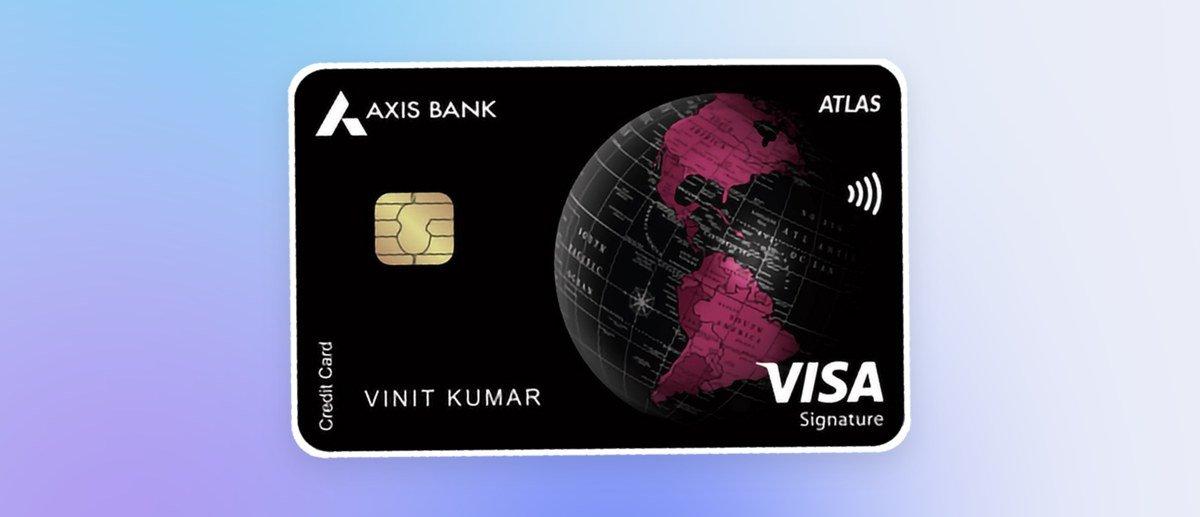
More credit cards: HSBC Premier · Axis Atlas · Axis Magnus · HDFC Infinia
Your Travel One points can go further
Let PointsFly track your points, find the best transfer for your next trip and turn them into flights and hotel stays.
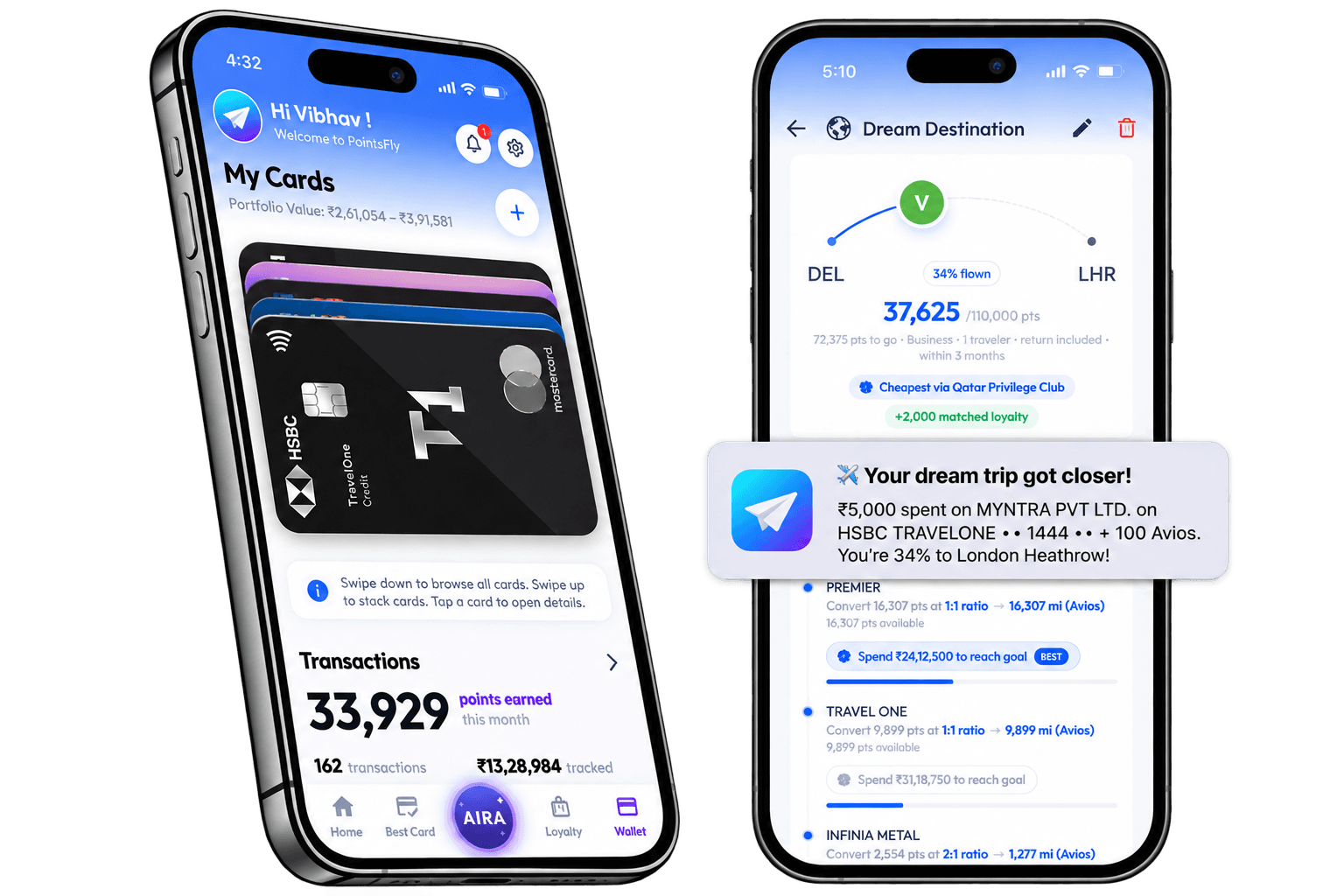
Download the PointsFly app
Track every card, see what your points are worth, and get the best flight and hotel deals for them. 7 days free.


HSBC Travel One credit card FAQs
What are the benefits of a HSBC travel one card?
You earn 4 points per ₹100 on flights, travel sites and foreign spends, and 2 per ₹100 on most other things. You also get 10,000 bonus points above ₹12 lakh a year, transfers to 20 airline and hotel programmes, most of them 1:1, 10 lounge visits a year and 15% off on travel sites like Cleartrip and Goibibo.
Is a HSBC travel one credit card worth it?
Yes, if you spend more than ₹8 lakh a year. The fee comes back from there, and you get back about 3% when you move points to KrisFlyer, or 5% or more when you transfer to Accor. Below ₹5 lakh a year, the ₹4,999 fee takes a big share of what you earn.
Is it easy to get a HSBC travel one credit card?
Fairly easy, if you live in one of HSBC’s 21 cities. Salaried applicants need ₹6 lakh a year and must be 18 to 65. Self-employed applicants need ₹12 lakh a year and must be 25 to 65. You can apply online and finish with video KYC.
Is the HSBC travel one card lifetime free?
No. Everyone pays the ₹4,999 + GST joining fee. From the second year, HSBC reverses the annual fee in any card year you spend more than ₹8 lakh, so it can work like a free card if you use it as your main card.
Does HSBC travel One give lounge access?
Yes. You get 6 domestic lounge visits a year through Mastercard and 4 international visits through LoungeKey. You don’t need to spend anything to unlock them, and add-on cardholders get their own visits. Guests aren’t free.
How much is HSBC travel one annual fee?
The annual fee is ₹4,999 + GST, about ₹5,899 in total. The joining fee is the same. HSBC reverses the annual fee if you spend more than ₹8 lakh in a card year.
How to waive HSBC travel one annual fee?
Spend more than ₹8 lakh on the card in a card year, which is about ₹67,000 a month. HSBC then reverses the renewal fee. Add-on card spends, bills and insurance all count, but go a little over ₹8 lakh since HSBC’s wording is “more than”.
Is it possible to get a HSBC travel one card for free?
Not in the first year, because the ₹4,999 + GST joining fee always applies. The welcome offer (₹1,000 cashback and a ₹3,000 Postcard Hotel voucher on ₹25,000 spent in 30 days) roughly makes up for it. After that, it’s free in any year you spend more than ₹8 lakh.
Researched with AI and reviewed by Vibhav Singh, founder of PointsFly.
Sources (checked 18 November 2026): every fee, rate and cap on this page comes from HSBC India’s own pages and documents. HSBC TravelOne credit card product page · HSBC TravelOne rewards page (transfer partner table) · HSBC Travel with Points page · HSBC TravelOne value calculator (PDF) · HSBC credit card Most Important Terms and Conditions and Key Fact Statement (PDFs) · HSBC Rewards Marketplace terms, including transfer times (PDF) · HSBC TravelOne lounge, milestone, introductory offer and purchase protection terms (PDFs)
Update log: 18 November 2026: First published. 19 November 2026: Point values updated. HSBC’s rewards terms give 1:1 on Travel with Points and the Apple store only to Premier and Privé cards, so we now value Travel One points at ₹1.20 (KrisFlyer) and ₹2.10 (Accor).
Card terms change often. This page reflects HSBC India’s published terms as of 18 November 2026. Confirm current terms with HSBC before you transfer or redeem.
PointsFly may earn a commission if you apply for this card through the link on this page. It does not change what we write, the figures above, or what the card costs you.